Tartu Youth Work Center

Creating an inspiring and innovative youth work environment

2018

From

5

The Youth Center

Ages 7-26

Target group

Tartu Youth Work Centre is a sub-institution of the Tartu City Government's Department of Culture, which began its activities on May 2, 2018. The center's goal is to create an inspiring and innovative youth work environment for young people in Tartu, so that they can develop into active, creative, and happy individuals.

Address:Uus 56, 50606, Tartu

Registration code: 77000720

Anne Youth Center

Uus 56, Tartu

Lille Youth Centre

Lille 9, Tartu

Ilmatsalu Youth Center

Järve Road 8, Ilmatsalu

Statute

Tartu Youth Work Centre's Statutes

Adopted 08.09.2020 No. 48

The regulation is established pursuant to § 21 (2) of the “Statutes of the City of Tartu” established by Tartu City Council Regulation No. 20 of April 26, 2018.

§ 1. General Provisions

(1) Tartu Youth Work Center (hereinafter referred to as the center) is a youth work institution administered by the Tartu City Government, operating under the administration of the Department of Culture.

(2) The center is the legal successor of Anne Youth Center and Lille Maja.

§ 2. Field of Activity of the Center

The center's field of activity is youth work.

§ 3. Task of the Center

(1) The center's mission is to create an inspiring and innovative youth work environment for the young people of Tartu, so that they develop into active, creative, and happy individuals.

(2) The center's activities to fulfill its mission are as follows:

1) organizing open youth work at the centre's activity locations…

2) organization of development projects and joint activities...

3) developing network cooperation with non-profit organizations and other youth work partners.

(3) The City Government may specify the center's tasks and establish metrics.

§ 4. Director of the Center

(1) The center is managed by a director.

(2) Director:

1) manages the centre, ensuring the fulfillment of tasks stipulated in the statutes…

2) is responsible for the general condition of the center, the use of funds, and assets...

3) represents the center and performs necessary actions...

4) compiles service descriptions…

5) approves the staff composition;

6) approves the rules of procedure;

7) ensures occupational safety;

8) approves job descriptions;

9) organizes the preparation of the budget application;

10) organizes the preparation of the development plan;

11) prepares an action plan;

12) ensures the submission of reports;

13) fulfills other obligations.

§ 5. Entry into Force of the Regulation

The regulation enters into force on October 1, 2020.

Urmas Klaas – Mayor
Jüri Mölder – City Secretary

Development Plan

Familiarize yourself with the Tartu Youth Work Centre's development plan here
https://drive.google.com/file/d/12AUfYagSvdQ-Yy7OsH4EXXI–oImLoWX/view?usp=sharing

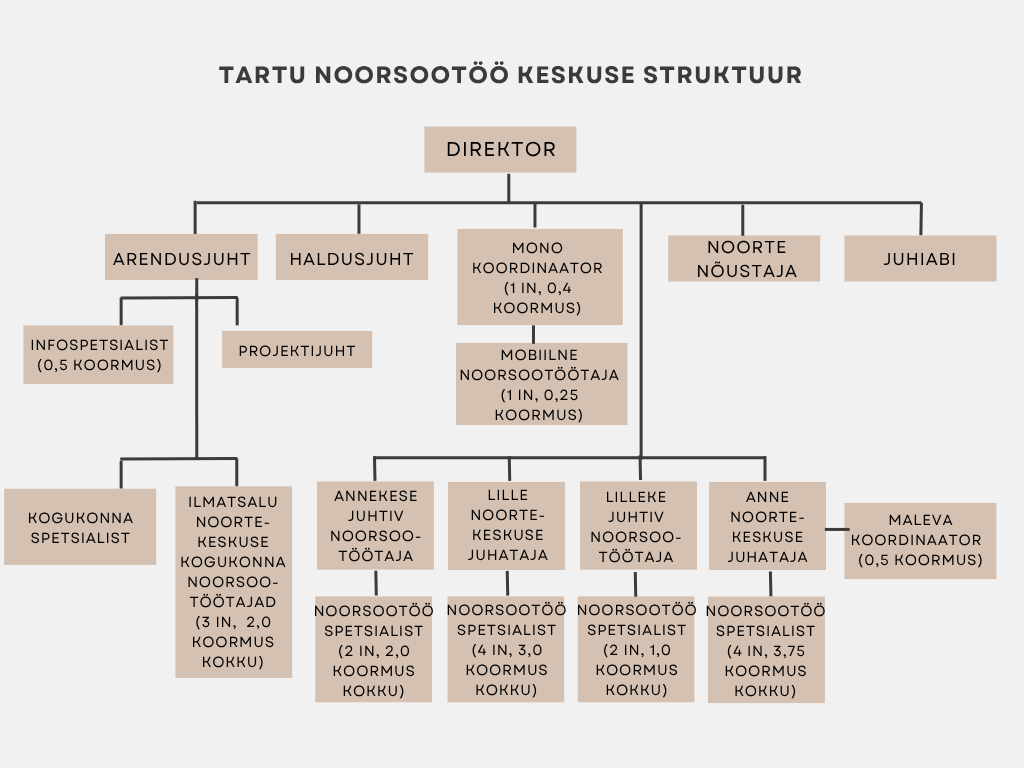
Structure

Symbolism

Logo story

Tartu Youth Work Centre's logo uses several elements that combine the following keywords into a whole: youth, growth, development, protection, and Tartu. A child steps under the protection of an umbrella, waving over their shoulder, to emerge from there bigger, more experienced, and more confident. Figures of different sizes allude both to growth and to the fact that the Tartu Youth Work Centre works with children of various ages.

The figures move in one direction, indicating progress and development, which the Tartu Youth Work Centre facilitates. The umbrella symbolizes the youth work centre and its branches, serving as a place for young people to come, offering shelter and protection in both a direct and indirect sense. The umbrella also references Tartu, creating a connection with one of the city's most famous symbols, the Kissing Students sculpture. Under the umbrella, the same motif is used as depicted in the Tartu logo, to align the Tartu Youth Work Centre's logo with the existing Tartu visual style. The pillar symbolizes the main building of the University of Tartu. The same vertical lines can also be interpreted differently: they meander through the middle of the logo, much like the Great Emajõgi River through the city of Tartu. In this context, the umbrella appears as an arch bridge, and two figures moving with a steady pace demonstrate that the river does not divide, but unites.

The author of the logo is Rain Jaaksoo.

Management

Management

Parking
Lille Youth Center (Lille 9) The youth center is located in the city center in a paid parking areain zone B. Parking on the street is paid from Monday to Friday from 8:00 a.m. to 7:00 p.m.! Free parking is allowedfor 90 minutes, and the start time must be marked with a parking disc. Parking is free on weekends and public holidays. Tariff in zone B: 1.5 euros/hour Mobile parking: Send an SMS to 1902 in the following format: vehicle number, space, parking zone code (e.g. 123ABC A15 / B90). To end, call 1903. Information line 1910 Source: https://www.tartu.ee/et/parkimine There are free parking spaces in the courtyard of Lille Youth Center for employees and tenants of Tartu Youth Work Center. Anne Youth Center, Uus 56 There are parking spaces in the courtyard of Anne Youth Center for employees and tenants of Tartu Youth Work Center. Ilmatsalu Youth Center, Järve tee 8 Parking in the courtyard of the Ilmatsalu Youth Center is FREE!
Come for an Internship!
The Tartu Youth Work Center welcomes interns! The innovative, education-minded, and youth-dedicated Tartu Youth Work Center is looking for enthusiastic interns who are motivated by the desire to contribute to the development of Tartu's youth. Why come to us for an internship?

An opportunity to gain very diverse experience working with young people.

An opportunity to connect with young people, be a role model for them, and, if necessary, advise them on various topics.

An opportunity to independently create and develop youth-oriented activities and projects that empower our youth.

An opportunity to work shoulder to shoulder with youth workers who have been active in the field for a long time.

An opportunity to participate in the organization of major events such as Knowledge Day, Youth Day, and Children's Protection Day.

An opportunity to create content for the center's various social media channels.

What do we expect from an intern?

Interest in working with young people

Sense of responsibility

Courage and openness

Ideas and a sense of mission

Positive attitude towards life

The ability to work both independently and in a team (or at least the desire to develop these skills)

Submitting questions The Tartu Youth Work Center welcomes interns year-round. Application and additional information: helene.toomeoks@tartu.ee
About Youth Work
Youth work is aimed at young people, specifically individuals aged 7-26, and focuses on creating conditions for the versatile development of a young person's personality. It enables young people to engage in activities outside of family, formal education, and work on a voluntary basis (Youth Work Act, 2020). Superficially, it might seem that a youth worker simply plays board games, cooks with young people, and just spends time with them. However, behind this lies a conscious and purposeful choice to contribute to young people's lives in various ways. Through non-formal education, young people are provided with the tools and environment to learn, discover, and create independently.  Youth work at the national level is managed by the Ministry of Education and Research and its implementing agency the Education and Youth Board (HARNO) and regulated by the Youth Work Act. Youth work is funded from the state budget through the Ministry of Education and Research, and at the local level, responsibility for organizing youth work, including the planning of financial resources, lies with the local government, which in Tartu is the Tartu City Government.  

Principles guiding youth work (Youth Work Act, 2020):  

  1) youth work is done for young people and with young people, involving them in decision-making;    2) when creating conditions for acquiring knowledge and skills, the needs and interests of young people are taken into account;    3) youth work is based on the participation and free will of young people;    4) youth work supports youth initiatives;    5) In youth work, the principles of equal treatment, tolerance, and partnership are followed.    Youth Worker the role of being a role model and mentor, supporting young people through specific life stages, in understanding and adopting societal norms, and seeking and supporting them in finding these resources both within themselves and externally. In their work, they adhere not only to the Youth Work Act but also to the professional ethics of youth workers.   Open youth work the aim is to offer young people opportunities to participate on a voluntary basis to support their activity and coping in social life, where openness and the free will of young people play a special role. This method enables youth centers to offer all young people developmental and meaningful activities tailored to their individual abilities and preferences, opportunities for success and improved self-esteem, regardless of their circumstances or social position.   In addition to the open youth work method, the Tartu Youth Work Centre also implements youth work as mobile youth work on the streets of Tartu and in the Tartu Youth Work Camp.     For young people and with young people!   Last updated 18.09.2023
Data Protection Terms

Data Protection Terms of Tartu Youth Work Centre

The main objective of the Tartu Youth Work Centre is to create an inspiring environment for the young people of Tartu and an innovative youth work environment. While performing our main tasks, we encounter in several cases together with the personal data of children or their parents. Next, we provide an overview of the purposes for which we use personal data, and how it is organized storage of data, including when it may be transferred to third parties to individuals and what your rights are in personal data processing. In cases that are not described below, we inform about the purpose of using personal data, its retention, etc. at the beginning of personal data collection (e.g., when obtaining consent). We ask for consent in such a way that it is clearly distinguished from other questions and formatted so that it can later be to certify (e.g., in a signed statement, email, SMS). The type of personal data collected depends on the specific service, but we always take into account with the principle of minimalism, meaning we only collect personal data that is necessary for our for providing services.

If you visit the youth centre

To support youth participation, to offer activities corresponding to their interests, and to ensure a safe environment, we register every visit. For registration, we use the logbook of the Estonian Association of Open Youth Centres (ANK). Youth Centre's On your first visit, an account will be created in the logbook with your parent's consent, and for this purpose we ask for first and last name, username (which the young person can choose themselves), place of residence country, local government, year of birth, gender, primary language of communication (can also choose not to disclose), educational institution (can also choose not to publish), in addition, it is possible to add your own and parent's email address, but filling them in is not mandatory. When registering the collected data will be used later for statistics. The data will be anonymized and The account will be deleted if the young person has not participated in the centres' activities for a long time. Information entered in the logbook is not disclosed to third parties.

If you register for an event organized by us

The data requested during event registration is used for the list of participants for compilation and to contact the participant if necessary. We store data for a reasonable period after the event ends, including considering with the need to contact participants regarding event-related information for submission. If the event is funded by European Union structural support, we will retain such event-related documents (e.g., registration forms) according to the rules set by the funder, which is typically 5 years after the completion of the respective project. Such events registration forms are marked with the symbol of the European Union. The funder has the right to review documents related to the funded project, including those of event participants with lists.

If you submit an application for a youth initiative project (NOA)

The data submitted in project applications and project reports will be used for the contract in concluding and overseeing the project's implementation. We will retain the NOA project application for 3 months. after the start of the new period. The period is from January to December. Reports and contracts we retain for 10 years after the contract ends.

If you subscribe to our monthly newsletter

By subscribing to our monthly newsletter, we will send information and news about youth centers directly to you. inbox. At the end of each newsletter, there is information on how to unsubscribe.

If you register for the youth work camp

The data requested on the registration form is used for forming youth work camp groups, for concluding an employment contract with a youth work camp participant and for an applicant to the camp or their to contact a parent/guardian. Data requested upon registration we delete within one year after the youth work camp has been finalized. We retain employment contracts for 10 years after the termination of employment. During the performance of the employment contract, we forward the youth work camp participant's data as required by the Tax and Customs Board for registering work and tax calculation.

If you participate in our activities as a volunteer

When concluding a contract with volunteer workers, the requested data will be forwarded for employment purposes. for registration with the Tax and Customs Board to the extent required by them. We retain contracts for 10 years after the end of voluntary activity.

If we record the youth centre's activities in pictures or videos

Since all interested individuals can participate in the activities of youth centres, the youth centre is public. a place, excluding the territory and rooms, where access for unauthorized persons is restricted according to limited. We will publish on the Tartu Youth Work Center website and social media accounts pictures/video material taken in a public place. Even then, only in cases where we are previously informed about photography or filming, and the young person has the opportunity to their own avoid being photographed. We do not publish pictures of minors. At our major events (Tartu City Children's Protection Day, Tartu Youth Day and Tartu Wisdom Day, Tartu Youth Party) we do not inform about prior recording, as their event's public considering its nature, it is reasonable to record there for the purpose of public disclosure to assume. In all other cases, we ask for consent to publish photos/video material. The employees of the Tartu Youth Work Centre are obliged to follow the same principles regarding pictures and when publishing video material also on their personal accounts. On the premises of the Tartu Youth Work Centre, measures are used for the purpose of protecting individuals and property. surveillance equipment (security cameras). You can find the justifications for using camera surveillance available for review with the center's assistant manager.

If you submit a request for clarification, a memorandum, or an information request to us

According to the law, we must [handle] documents sent to and prepared by our institution to register documents in the document register. The name of a private individual sender or recipient, we... does not disclose, and only the name of the private sender or recipient is visible in the public view of the document register initials. If you write to us on behalf of a legal entity or institution, please use not their private, but professional contact details. Such contact details are public in the document register. If an incoming letter contains information not subject to disclosure data, it is recognized for internal use within the institution upon registration. We use the data provided in the request solely for the purpose of responding to you. If we need to to respond to additional inquiries, we only disclose personal data to the minimum extent necessary to achieve this purpose. If sent to us the response to the request falls within the competence of another institution, we will forward it to the aforementioned to the institution and we will inform you of the corresponding transfer. Correspondence with private individuals is retained for 5 years, after which this period documents exceeding their retention period for destruction. We use a common system for Tartu City Government and its administered institutions document management system GoPro. Designated for internal use documents are accessible only to city government employees who need them for performing service duties (e.g., city government IT department, document management system key user, data protection officer).

If you apply for a job at the youth work centre

When applying for a job, we process the personal data disclosed by the candidate to assess suitability to the respective position. To assess suitability, we collect additional information about the candidate from public sources. We assume that the applicant has given permission to the referees listed in the application documents consent to answer questions about themselves, and the recommenders have also agreed that we may contact them for information. As part of the recruitment process, we retain received documents for 1 year. to resolve any potential legal disputes that may arise, as well as to the next in ranking to make an offer of employment to the candidate or with the candidate's consent to make a proposal for participation in a future competition. Before signing an employment contract, we check the criminal records to ensure there are no circumstances that would exclude the employment of a worker as a person working with children. We make the same inquiry for all regarding youth center staff at least once a year. Employment contracts are retained for 10 years after the termination of the employment relationship.

Different types of contracts (cooperation agreements, rental agreements)

To conclude contracts, we ask for data necessary for fulfilling the contract (organization name, registration code, address, name of the authorized representative, phone number, email address). Contracts are registered in the document management system and retained for 10 years. after the contract ends.

To whom we forward your data

All personal data we collect is intended for use solely within the youth work center. and within the framework of reporting, we only release data in an anonymous form. The youth work center may use various information systems in its activities (ANK logbook, SPOKU, the information system for submitting and processing applications of the City of Tartu, the city's document register GoPro), whose owner/administrator/host processes personal data only to the extent necessary for the operation of the information system and guided by our personal data processing conditions. The processing of personal data related to these information systems principles may be reflected in the terms of use of a specific information system and/or in the statutes of the information system. In all cases not described above, we only transfer personal data to third parties only when such an obligation is mandated by law. For example, we must report a child in need. to the child protection worker, in employment relationships we must submit data to the Tax and Customs Board, To the Health Insurance Fund, the Social Insurance Board, investigative bodies in criminal proceedings, to the court upon request to the court, to supervisory authorities in national supervision proceedings, official to the city government during supervision.

How you can access your data

You have the right to access all data we have collected about you. To do this, contact the youth work center in person or send a digitally signed application to carolin.koiv@tartu.ee. To access personal data, we must be sure that it is the individual who has right to receive relevant data. Therefore, we may request the necessary information for identification submission of additional information. We will respond to such inquiries within one month at the latest. We will only refuse to fulfill a request to access personal data if it may: – harm the rights and freedoms of another person; – harm national security; – prevent or impede the prevention, detection, investigation, or punishment of criminal offenses completion.

If you have a concern or complaint

If the processing of personal data is based on prior consent, you have the right to consent withdraw at any time. You have the right to request the correction of personal data if it has changed or otherwise reason, insufficient, incomplete, or incorrect. Additionally, you have the right to request incomplete the supplementation of personal data based on the specific processing purpose. You have the right to request the restriction or deletion of your personal data processing. In particular, in cases where we no longer have a legal basis for processing your personal data. You do not have the right to request the deletion of personal data in cases where are processed based on law or for the performance of a contract, and the processing of personal data The purpose has not been abandoned, nor has the retention of collected data commenced. deadline. You have the right to object to our decisions and activities at any time as a complaint or appeal to the administrative court. You also have the right to file a complaint with the Data Protection To the Inspectorate. In case of additional questions regarding personal data processing operations, you can contact the data protection specialist at andmekaitse@tartu.ee.

Contacts

Tartu Youth Work Center

Uus 56, 50606, Tartu

Reg. no. 77000720

For additional information and specific questions, please see our contacts page.