
For the young people at Annekese, helping staff with cleanup tasks is one way to ground themselves while also developing the ability to appreciate their surroundings. Teaching them to keep things tidy is important because habits and values are formed in childhood and continue to shape them well into adulthood. Tidying up the surrounding environment teaches young people a sense of responsibility, care, and respect for both nature and other people. Through joint cleanup and tidying activities, they develop teamwork skills, creativity, and the ability to identify and solve problems. In addition, it teaches children that everyone can make the world a cleaner, more beautiful, and better place through their own small actions!
Here are a few tips for you to try out with young people—they’ve worked well at Anneke for engaging young people:
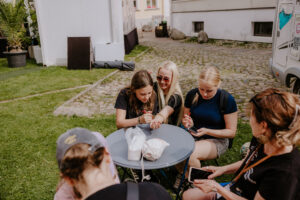
- Together, we can organize a fun cleanup outing where we collect trash and learn how to keep nature clean. During one spring break cleanup event, for example, the young people got so into cleaning up the area around Anne Canal that they didn’t want to stop. The goal wasn’t just to collect as much trash as possible, but also to examine it, since a prize awaited the participant who made the most interesting discovery.
- Recyclable materials can be used to create amazing works of art. Even the most mundane trash can be transformed into the world’s coolest artwork by using existing resources.
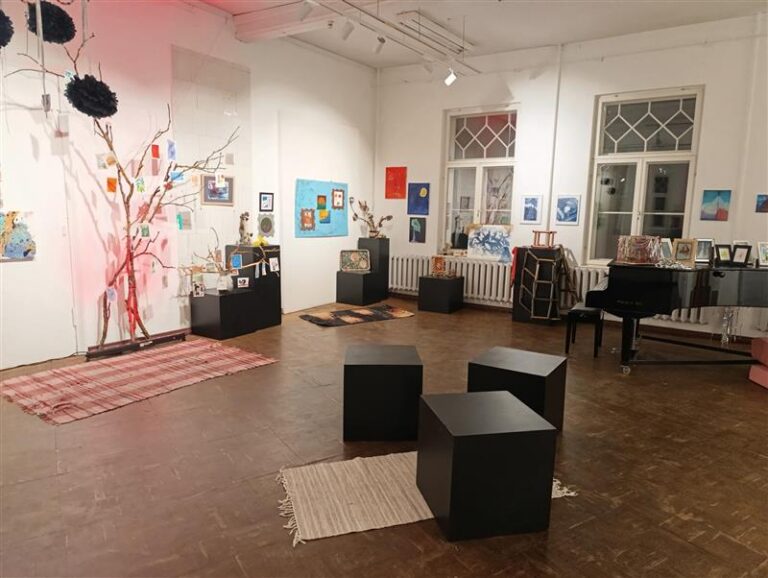
- Remind the young person that the ability to appreciate art can be learned—you just have to give it a try! While creating works for the art exhibition, the young people often struggled with the fixed idea that if a single mistake accidentally crept into their creation (a paint splatter, a crease, etc.), it was an obstacle—all their hard work had gone to waste, and now the entire piece had to be thrown away. We reminded the young people that a mistake is actually an additional opportunity. If something goes wrong, you have to be kind to yourself and think about how to use it to the work’s advantage.
- In the rock-painting workshop, you can make your everyday surroundings more colorful and cheerful. We’ve turned small rocks into refrigerator magnets, while larger rocks can be used, for example, as doorstops, checkpoints for relay races or orienteering, or as decorations in flower beds.
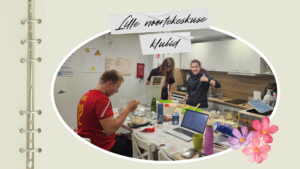
- At the cooking club, you can use whatever you already have in your pantry! Once a month, we’ve been hosting a cooking club at Anneke’s, where participants have to create a dish using ingredients found in the pantry.
- The “Good Deeds and Cleanup Challenge” was the brainchild of one of the young people at Annekese, who saw an opportunity to get others involved and earn play money in the process. That’s right—play money! Maksym made a list of cleanup tasks that could be done at the youth center: washing dishes, sweeping the floor, organizing the game shelf, and more. Each activity had its own “reward” in the form of play money. This has probably been the most impressive example of initiative that this writer has witnessed firsthand: the young people weren’t actually interested in the opportunity to earn money, but rather in the visual feedback on their active contribution to the youth center, because the “piles of money” kept growing, and at the same time, they noticed and brought to the leader’s attention when something needed tidying up.
- The most important thing is to give children the opportunity to come up with their own ideas, experiment, and work together, because this fosters their sense of responsibility and helps them realize that even little hands can make the world a better place! This is a principle we’ve often had to remind young people of, because if an idea can’t be implemented quickly, the young person loses their motivation to contribute. Many ideas, however, take time. So we’ve asked young people who, for example, want to carry out a self-initiated project at the center to work with a staff member to think it through and put it in writing, so that both visible and invisible resources can be used as wisely as possible.
- With younger target groups, it often starts with the staff member setting an example. You start doing something yourself, and the next moment a soft voice asks from behind, “How can I help?”—either wanting to see the task through to the end or, on the contrary, being so inspired by the youth worker’s actions that they begin to imitate them. It’s happened quite often that when we start a big cleanup, young people join in on their own initiative because they saw us getting things done.
I hope that Anneke’s experiences will give you some ideas to try out when working with young people. Finally, all that’s left is to wish you the best of luck with your work!