
Many 21st-century skills are closely linked to thinking skills. These include, for example, creative and critical thinking, as well as a collaborative and caring mindset. These skills can also be developed in youth work through philosophy with children and young people.
Philosophizing creates more space for discussion and helps participants become more skilled at articulating their opinions, listening to others, making decisions and choices, and solving problems. Through this practical activity, students can develop their argumentation and analytical skills, critical thinking, and communication skills.
This is an activity that does not require the use of the term “philosophy” or the examination of philosophical theories. Rather, it is important to create a space for questions, reflection, further thought, making connections, and doubt. Such a conversation helps students practice reasoning, drawing conclusions, comparing, identifying causes, summarizing, and organizing their thoughts. It also fosters the ability to recognize different possibilities and discover new—and sometimes unexpected—alternatives.
As youth workers, we can facilitate discussions and encourage participants to reflect together on different ideas and viewpoints. We can create a safe environment, listen actively, and, if necessary, ask participants to clarify or justify their thoughts. In this role, we can encourage children and young people to speak up, listen to one another, think independently and creatively, express their opinions, and build on the perspectives of others.
Mutual agreements also play an important role in philosophical discussion. For a conversation to work, it is necessary to listen to one another, wait for your turn to share your thoughts, and learn not to ridicule others’ ideas or pass judgment on them. It is also important to agree that speaking is voluntary and that participants may choose to think along silently if they wish. Such agreements help create a safe and respectful atmosphere and foster the ability to take responsibility for one’s words and behavior. In this way, philosophical discussion helps develop not only critical thinking skills but also self-control and consideration for others.
Topics for philosophical conversations can arise from the everyday lives of children and young people, as well as from practical activities in youth work. For example, we have practiced philosophizing in a cooking club, where exchanges of ideas can arise naturally while preparing food. Topics for discussion might include what constitutes good food, what hospitality means, or why some families or cultures eat different kinds of food. Similarly, we can talk about what friendship is, why we learn, why we go to school, or what it means to do a good deed. Such conversations do not need to lead to a single, definitive understanding, solution, or conclusion. What is more important is that the exchange of ideas opens up new perspectives and gives each participant ideas to explore further.
In youth work, philosophical dialogue is a valuable way to support children’s and young people’s self-expression, critical thinking, and consideration for others. It helps create an environment where every participant feels that their thoughts matter and where different opinions can be expressed and listened to calmly and respectfully. Thus, philosophizing is not just a conversation, but also a way to support a child or young person’s development into an independent, self-confident, caring, and thoughtful individual. Many of the thoughts and ideas discussed in this article were inspired by the training course “Inclusive Values.”
"Youth: A Practical Toolkit for Teachers on Values Education," which addressed values education and the development of reflective and collaborative thinking through the method of philosophy with children and youth.
Author: Merle Tensig, Community Youth Worker at the Ilmatsalu Youth and Community Center
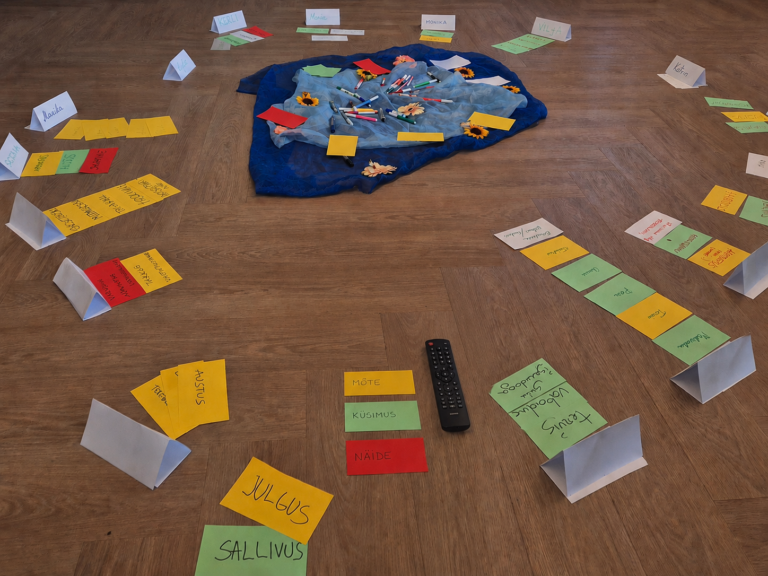
Photo: Merle Tensing, notes from the training session “Youth with Inclusive Values: A Practical Toolkit for Teachers on Values Education”