
Youth worker Kristina talks about 5 ways how to make your day more productive!

The current emergency situation has forced many people into home schooling, and it is very important to be able to plan your time and needs. Here are five different ideas on how to plan your time more effectively at home, so that everything necessary gets done and your mind remains sharp.

1) Create a daily plan

Start each morning by creating a clear daily plan. Also, write down how much time you would like to spend on each activity. You can include responsibilities, rest time, exercise, and other activities important to you in your daily plan. To create your plan, you can use a notebook, a mobile app, or a whiteboard, for example. Writing down your activities helps you stay on track and avoid things piling up. Of course, it also feels good to cross off completed tasks.

2) One thing at a time

Focus on one thing at a time. It's a known truth that multitasking doesn't get you very far, and doing several things at once is not very effective. Many people believe they can handle multiple activities simultaneously, but in reality, these often end up being done incompletely. If a task seems extensive, divide it into smaller parts. This approach also helps maintain motivation.

3) Remove distractions

To truly get things done, it is important to focus. Close external distractions, such as Messenger, Instagram, TV, etc., which can hinder your concentration. For some people, quiet music helps them concentrate better, while for others, it does not work. Also, try to tackle more difficult tasks in the morning, as brain activity is sharper then, and solutions come more easily.

4) Know your learning style

It's beneficial to know which learning style suits you best. Do you acquire new knowledge most effectively through auditory, visual, or kinesthetic methods? Knowing this allows you to utilize it efficiently to your advantage. You can take a test, for example, on the Saaremaa Co-educational Gymnasium website: https://www.syg.edu.ee/~peil/opi_oppima/stiili_test.html

5) Find time for resting and doing favorite activities

As we spend hours in front of various screens, it's important to also leave time for rest and favorite activities. Be sure to take breaks during studying: stretch, look out the window, or call a friend, for example. Praise yourself when fulfilling your duties. At the end of the day, for example, write down three activities that went particularly well or things you are grateful for today. Also, find time for walking, running, or other forms of physical activity outdoors.

We wish you productive home schooling and hope that we can return to school soon!
news:

Do digital environments bring us together or make us more lonely?

Have you ever had a day where you’ve been chatting with friends on Snapchat, Instagram, or Discord all day long, but still feel lonely in the evening? It might seem strange—how can we feel lonely when we’re connected to others almost all the time? Loneliness is a topic that’s being discussed more and more. According to the World Health Organization, about

Read more »

Philosophizing with Children and Youth

Many 21st-century skills are closely linked to thinking skills. These include, for example, creative and critical thinking, as well as a collaborative and caring mindset. These skills can also be developed in youth work through philosophizing with children and young people. Philosophizing creates more space for discussion and helps participants become more skilled at articulating their opinions, listening to others, making decisions, and

Read more »

The Tartu Youth Work Brigade’s anniversary summer kicks off with a parade and an evening of work brigade songs

Today, June 15, Tartu will kick off the 30th summer of the Tartu Youth Work Camp, which will bring together 238 young people this year. The opening event of this anniversary year begins at 4:30 p.m. in the courtyard of the Anne Youth Center and proceeds with a parade to Town Hall Square, where the start of the work camp season will be celebrated with a speech by Mayor Urmas Klaas and the taking of the work camp oath. The opening ceremony will be followed at 7 p.m. by an evening of work camp songs in Tartu

Read more »

Ukrainian Youth in Tartu: A Week That Left a Lasting Impression

In early June, from June 8–14, the Tartu Youth Work Center had the extraordinary honor and pleasure of hosting young people from Ukraine—young people whose lives have been completely turned upside down by the war. The camp was made possible thanks to financial support from the City of Tartu, and the Tartu Youth Work Center wholeheartedly took on the task of organizing the program. The week began creatively—in a stencilling workshop, the young people

Read more »

A Children's Day bursting with joy and youthful energy!

The theme of this year’s Child Protection Day was the question: “A young person speaks—are you listening?” The need to be seen, heard, and truly listened to became clear right from the first preparatory meeting, where young volunteers had the chance to share which topics they consider important in the daily lives of children and young people. Almost without exception, all participants highlighted today’s fast-paced lifestyle—home,

Read more »

A mobile youth center will be on the move in Tartu this summer

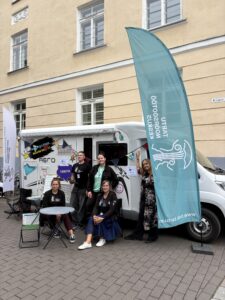
From June 1 to September 1, the Tartu Youth Work Center is launching the MoNo bus—a youth center on wheels—as part of a pilot project, bringing youth work to young people at their everyday gathering places. It is a specially adapted van designed to provide young people with a safe and supportive environment in areas where youth work services are currently unavailable or where young people cannot easily access them on a daily basis. MoNo

Read more »

Youth workers from the Tartu Youth Work Center on a study trip to Portugal

From April 19–26, youth workers from the Tartu Youth Work Center participated in a study trip to Lisbon, Portugal, as part of the Erasmus+ program, to learn about local street youth work methods, non-formal education, and ways to support young people in the NEET situation. Study trips give youth workers the opportunity to step outside their usual work environment for a moment, learn about different practices, and bring the knowledge and effective solutions they gain back to their own community (Pavlakias and

Read more »