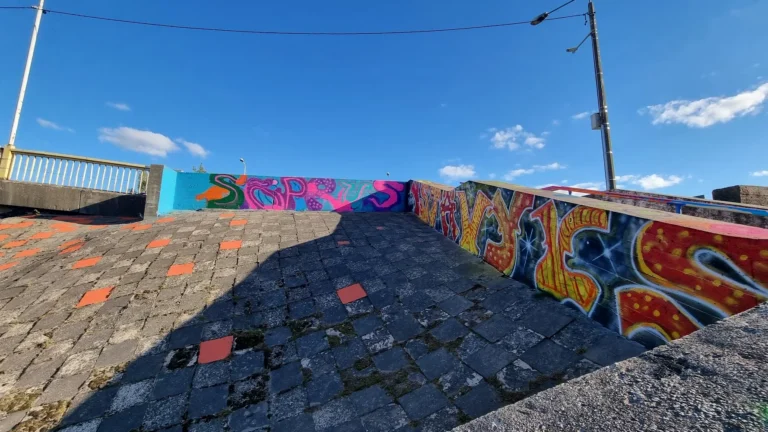
From September 5th to 9th, there was a lot of activity under the Sõprus Bridge. Specifically, a large mural, or rather murals, were created there in cooperation with Estonian and Finnish street artists and young people, as several walls, stairs, and even asphalt were covered, totaling over 500 square meters.
The main goal of the activity was to offer young people the opportunity to learn and legally contribute to public art.
The young people were guided by the group SirkusRakkausPumPum, who have extensive experience in similar ventures.
Participant (15): “I liked it. It's great that something like this was organized and that young people were involved in the process. There aren't many opportunities to do proper street art, or at least I haven't come across any. So it was a very special experience."
Second participant (15 y.o.): “It was great and I liked it. Everyone was helpful and willing to assist when we had questions, and usually you don't really come across such projects, especially when you're younger and don't have much experience, but it was really cool and I would participate in more such things in the future. We were given much more freedom of choice with our tasks than I would have expected.”
The mural was completed for the 30th anniversary of sister cities Tartu and Tampere, and therefore, friendship was its overarching theme.
The ceremonial opening of the mural took place on September 10, where welcoming remarks were given by, among others, Tartu Mayor Urmas Klaas and Tampere Deputy Mayor Aleksi Jäntti.
The project was led by Tampere House and was part of the Diggiloo – Digital Cultural Production from Youth to Youth program.
Glossary:
The umbrella term is public art, under which street art, muralism, (name-based) graffiti, and somewhere on its fringes, vandalism, fall as separate categories.
Street art is distinguished from other public art by its spontaneity and a certain anarchic quality.
A large-scale wall painting is a mural. This is also why large wall paintings, which are often called street art, are not, because if one wants to create them, one must go through bureaucratic hurdles and get the work approved. The artist is not the sole author of the idea; many people contribute their ideas and conditions, so it is not the artist's independent vision. A large mural requires available space, permission from the property owner, and financial resources for renting lifts and purchasing paints. A similar process occurs as in art galleries, where a curator selects the artist and the works.
Source: https://www.ajakiri.ut.ee/artikkel/2642