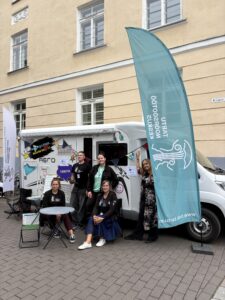

A young Turkish student, Beyza, has come to our organization for an international internship. We conducted a short interview with her to get to know her better. In the interview, you can also learn more about how young people from other countries view the youth work situation both in our country and in their own.
Enjoy reading!
[dt_gap height="10" /]
[dt_divider style="thin" /]
Please introduce yourself to us in a few sentences.
My name is Beyza Göl. I am from Turkey and I am 23 years old. I study International Relations at Ege University in İzmir.
[dt_gap height="10" /]
Why did you decide to come to Estonia?
I came to study at the University of Tartu as an exchange student through the Erasmus+ program. I chose Estonia because I wanted to experience northern Europe. I wanted to learn about a different climate, culture, and way of life.
[dt_gap height="10" /]
What has surprised you the most during your time in Estonia?
Definitely the weather and Estonians' ability to adapt to it.
[dt_gap height="10" /]
What do you like about youth work?
In my opinion, one of the best ways to get to know a new cultures is to meet the young people of that region. That's why I wanted to do my internship at the Tartu Youth Work Center. I have been pleased to experience how youth work operates in Estonia and how young people are treated, as well as the opportunity to converse with future generations.
[dt_gap height="10" /]
Could you tell us what youth work looks like in Turkey? What are the biggest differences compared to Estonia?
Youth work in Turkey differs radically from that in Estonia. Turkey does not have standardized and qualified youth centers for children and young people throughout the country. The Ministry of Youth and Sports has started to establish youth centers at universities, but first we need these centers for young people aged 10-18. Young people of this age have nowhere (except the streets and playgrounds) to spend their time after school or during holidays. Universities offer basic facilities such as music rooms, art rooms, and outdoor activities, as well as opportunities for camping, hiking, and sports. However, these are not standardized across the country. Estonia has created many more opportunities in terms of resources than Turkey. Unfortunately, youth centers must also operate in accordance with government policy and are not free to choose their own activities. For example, it is not possible to hold Pride parades or work to raise LGBT+ awareness, because youth centers operate under the authority of the Ministry of Youth and Sports.
[dt_gap height="10" /]
What are currently the biggest challenges for Turkish youth?
Turkey has been in an economic crisis for the last 4-5 years. This has affected a large part of the young population both psychologically and socially. They are hopeless about their future, finding it difficult or even impossible to afford basic social activities, such as going to concerts, the theatre, or traveling outside the country. It is particularly noticeable on social media that a large number of young people believe that even after several years of schooling and university, they still won't find a decent and well-paid job.
[dt_gap height="10" /]
How long will you stay in Estonia, and would you like to come back?
My Erasmus+ program lasts five months, and I will return to my home country at the beginning of July. However, I would probably not choose Estonia as my permanent residence due to the climate.
[dt_gap height="10" /]
What are your plans for the summer?
I have summer school in the summer, and then I have a long vacation. 😊
[dt_gap height="10" /]
Now you too have met Beyza. We hope it was an interesting read and perhaps gave you some food for thought.
[dt_gap height="10" /]
[dt_divider style="thin" /]
[dt_gap height="10" /]
[dt_gap height="10" /]
[wpforms id="19022" title="true" description="true"]