
Lille Youth Centre's health tip: Is dessert really unhealthy?

There is a widespread misconception in society that dessert is unhealthy and a real sugar bomb.
Dessert usually refers to products made from processed ingredients, sugar, and fat, bought ready-made from stores. In such cases, the consumer cannot control what and how much goes into the dessert or how it is made. There is less of a habit to prepare dessert at home. However, it is much safer to eat food that you have prepared yourself from start to finish and whose ingredients you are aware of.

Many sweet products sold in stores contain fast-absorbing carbohydrates, which are burdensome for the body in large quantities. While such carbohydrates provide quick energy, appetite returns just as quickly, energy levels drop, and fatigue sets in. In contrast, fruits and whole grain products, for example, contain slow-absorbing carbohydrates, which create a longer-lasting feeling of fullness and provide energy for a longer period, which in turn positively affects mental health. 

When buying, eating, and/or making sweets, one should also consider the energy generated and how to utilize it. Very often, sweets are consumed without any subsequent activities, leaving young people unsure what to do with the large amount of energy, causing them to spend it aimlessly. After eating, whether it's savory or sweet, it's good to go outside to expend that energy and make the most of the received energy. When they come back inside, they still feel full, but without excess energy.

In our work with young people, we have tried to find healthier alternatives to conventional store-bought sweets and make the foods prepared in the cooking club healthier. In the cooking club, we have agreed to make smaller quantities so that everyone gets a sweet treat, rather than making too much and risking a sugar overload.

Here we present some ideas and tips that we have applied when making desserts and which have worked well for our young people: 
  • using oats in making cookies;
  • use of whole grain products;
  • using fruits in recipes, for example, when preparing fruit salad or avocado mousse;
  • using berries and fruits as snacks, replacing cookies or other sweets;
  • transitioning from syrup and juice to water; if necessary, (frozen) berries or citrus can also be added to the water.
We also share some simpler tips to try to make young people's snacking healthier: 
  • to look for healthier alternatives for food products, e.g., use oat flour instead of wheat flour, unrefined sugar instead of white sugar, etc.;
  • instead of buying ready-made dough, make the dough at home to be aware of what it contains;
  • use fresh ingredients when baking, decorate with fruits, for example, or make carrot cake instead of a regular cake;
  • to make smoothies from your favorite fruits, which provide freshness and create a feeling of fullness;
  • use seeds, nuts, frozen berries, or fruits as a snack;
  • for example, replace sugar with honey when drinking tea;
  • to search for help online to find a healthier and more appealing recipe.


No dessert is unhealthy as long as attention is paid to the quantity of food consumed. At the same time, it is important to monitor the ingredients and, if possible, prepare the dessert yourself. In that case, you can control what nutrients you are giving your body. The healthier the food consumed, the happier and more alert the body and mind will be. 

Finally, we share a cookie recipe that won the hearts of our young people: http://maitsevhea.blogspot.com/2011/02/kupsised-kaerahelveste-ja-sokolaadiga.html


Angela Dulinets, Liis Küpar
TNTK Youth Workers
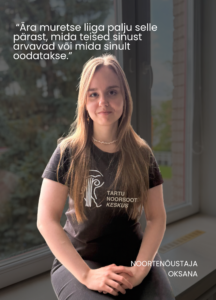
 

The focus of Lille Youth Centre is health, meaning that in addition to other activities, particular attention is paid to health – both physical and mental – to create an environment that fosters good habits for young people.
Cooking clubs are held once a week in all youth centers of the Tartu Youth Work Center, and on Thursdays at the Lille youth centers. Additionally, a health club is held at the Lille youth centers for 12-19 year olds, where various topics related to both mental and physical health and their support are discussed, such as self-love, the importance of sleep, music therapy, and much more. 

news:

The Tartu Work Brigade is opening its anniversary exhibition today at the Tartu City Museum!

Today, April 17 at 4 p.m., the Tartu Youth Work Brigade’s 30th anniversary exhibition will open in the courtyard of the Tartu City Museum, bringing together brigade members from different generations and telling the story of how young people’s work habits have evolved over three decades. For many young people aged 13–19, the Tartu Youth Work Brigade has been their first exposure to working life. Over the course of thirty years, thousands of young people from Tartu have participated in the brigade,

Read more »

Diversity, Equality, and Inclusion — Our German Learning Mobility Program

Diversity, equity, and inclusion in youth work mean creating a safe and supportive environment where differences are not only acknowledged but also genuinely valued and encouraged. This means ensuring equal access, active participation, and a sense of belonging for all young people. This approach goes beyond merely taking into account differences in origin, gender, abilities, or orientation; it is aimed at removing barriers, expanding opportunities for marginalized and minority groups, and ensuring their full inclusion in all activities. Inclusion

Read more »

For Your Information: Sleep as a Superpower

With the arrival of spring—accompanied by birdsong and the awakening of nature—comes a period that is stressful and hectic for so many young people and adults alike. Whether it’s due to graduations, the final stages of various projects, or simply the anticipation of summer. During this time, it’s important to take care of your health and maintain your routines, one of the most important of which is a healthy sleep routine

Read more »

Connected internationally! A week in Latvia—fun, interesting, and memorable!

Eight young people from the Tartu Youth Work Center had the amazing opportunity to take part in the “Toolbox for Tomorrow” youth exchange in Latvia, which focused on digital tools, environmental development, design, and storytelling. Over 40 young people from Estonia, Latvia, Turkey, Italy, and Hungary took part in the youth exchange. On March 7, we set off with the group from Tartu train station toward Valmiera,

Read more »

The Erasmus+ project gave young people the opportunity to organize their own esports event

At the end of February, the A. Le Coq Sport Sports Center was filled with e-sports enthusiasts for the Game in Tartu 2026 festival, dedicated to gaming culture. Over the course of two days, nearly 500 people from across Estonia visited the event; 20 organizations showcased their activities; and more than 50 organizers and volunteers contributed to the festival’s success. As part of Game in Tartu 2026, there was

Read more »

The Tartu Youth Work Brigade is celebrating its 30th anniversary with a new visual identity

This year marks the 30th anniversary of the Tartu Youth Work Brigade. This is a significant milestone that demonstrates Tartu’s consistent commitment to providing young people with their first work experiences, fostering their independence, and developing their social skills. To mark the anniversary, the work camp has also received a new visual identity that uses vibrant colors to reflect the energy of young people and brings together symbols that are important to the camp participants.

Read more »

School Break City Camp – One Day, One Place, Lots of Fun!

We put together a varied program for every school break, but City Camp Day is the most special day of the entire break. On this day, Tartu’s youth gather at a single youth center. While all five centers are usually open, during City Camp, activities take place in just one location. This gives young people the chance to visit a place they might not otherwise go to on a daily basis

Read more »