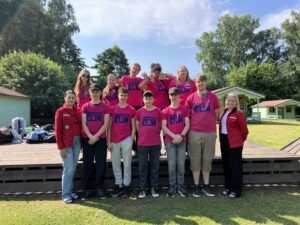

From July 24-26, the Ilmatsalu Youth Centre once again took young people to the forest for nature survival training days. The location was also an old acquaintance – Simisalu Nature House and Kollassaare. The trainer was also our old friend Erki Vaikre from Estlander MTÜ.
One might assume that the training was of the same content as previous times. Yes, it was, but with the exception that everything discussed during the training days was also translated into sign language. Specifically, we had an excellent opportunity to conduct joint survival training days with the Estonian Deaf Youth Organization (EKNO).
We started planning quite early, when a state of emergency was still in effect in Estonia. Since there were still difficulties with accommodation and restrictions applied to getting into RMK forest cabins, we had to plan various options. For the participants, it didn't matter whether we stayed in a tent, a forest hut, or just under the open sky, but for the sign language interpreters, we wanted a less extreme experience. Fortunately, we eventually received confirmation that it was possible for everyone who wished to stay at Simisalu Nature House.
On Friday, July 24th, we gathered at the nature house, and as an introductory and informative part, deaf young people conducted a small training session and fun ice-breaking games for all of us. It turns out that sign language is not exactly 'Chinese' to a novice; many signs are quite natural. Think to yourselves what the signs might be for the words 'book, sun, ball, bear, apple'. A cheat sheet can be found under the 'Estonian Sign Language – Estonian Language Dictionary' on the website of the Institute of the Estonian Language. Therefore, be more confident when communicating with people who speak sign language.

However, our main activity, or rather, survival in nature, began on a very rainy morning on Saturday, July 25th, when we gathered in front of the nature house to go with trainer Erki to Kollassaare, which is located about 4 km from the nature house, between bogs and swamps. On the way there, we heard stories about the history of the place, its traditions, as well as animal life and edible plants. We made a stop at both a sacred tree and a sacrificial stone. Kollassaare is an old farmstead where an old barn, a well, and a cellar still remain. The spirit of the place, who maintains this area and organizes heritage and survival trainings, is the Estlander NGO team. Many thanks to them for this.
The first major challenge was the bog walk that was about to begin. On the way to the bog, between stops, the other trainer, Romas, spoke about the origin of bogs, their peculiarities, the difference between a swamp and a bog, and the animals and plants of the bog. I must mention right away that there were a lot of cloudberries, blueberries, and cranberries. We stopped at a teepee erected on a bog island and mentally prepared to 'dive' into the bog. For the bog walk, we had neither boardwalks nor snowshoes, but our own two feet and a long wooden stick as a walking aid. The instructor vividly and practically demonstrated how to move in the bog, what absolutely not to do, and also how to act if you have sunk chest-deep into the bog. An important piece of knowledge and the foundation of everything – stay calm and don't struggle. Since there was literally no way back, we had to keep going forward, through pools and hollows, aided by a longer stick and remembering the words we had just learned. Since we moved carefully, with a few bolder exceptions who tried to 'sink' a bit, we emerged from the bog surprisingly dry, with only wet shoes. At Kollassaare, we were able to change our wet clothes and shoes for dry ones, eat a delicious lunch (vegetarian this time, by the way), and the next lesson began. We watched and tried how to use common tools – different saws, an axe, a knife. We listened to a talk on the topic of water. Specifically, how much water a person needs in general, how and where to find water in the forest, how to filter it if necessary, and how to boil water if you don't have your own containers with you.

If you are lost in the forest and know you have to spend the night there, you can build a shelter to stay warm. We received plenty of tips on exactly how to do this and what to consider. It's also important to start a fire, which provides warmth and can be used to prepare a warm drink or food. As a side note, at the training location, we always had a campfire with water simmering on it. We added plants we collected along the way – meadowsweet, fireweed, raspberry stems – to the water, and delicious herbal tea was always available.
Since fire-making has been mentioned several times, we also got to practice it. When going into the forest, the problem is always that Estonian weather tends to be rainy and damp. So, if you take matches into the forest, even if you've packed them waterproof, the matches still get damp, and it's impossible to start a fire with them. Even a lighter can fail. This is where fire steels come in handy. Everyone got to try starting a fire with fire steels; all that's needed is to find the right material in the forest and use the correct technique with the fire steels. No one was left in trouble with this, even if getting a flame was very difficult.
 Once fire-making was clear, it was time to prepare dinner over the campfire. For this, each participant received ingredients to cook over the fire – mushrooms, bell peppers, potatoes, bread, roasted onions, plant-based butter, and vegan sausages, and naturally, herbal tea to drink. Bellies full, campsite cleaned, dishes washed, we moved back to the nature house. There, the campfire evening continued, where dessert was prepared over the fire – cookies with marshmallows and dark chocolate. A long and physically active day had not managed to tire us out, and by the campfire, games were played, people ran around, socialized, and simply enjoyed the evening. Since quiet communication (in sign language) continued for longer, we did not enforce a strict lights-out. Board games and socializing continued in the nature house's dining room. When everyone went to bed around 3 AM, an unplanned wake-up occurred at 3:30 AM. Specifically, the house alarm went off. Unfortunately, I couldn't turn it off, so we waited for the owner, who fortunately lives nearby. It turned out that too much moisture had entered the corridor, and the system mistook water vapor for smoke. The alarm was so loud that even the deaf heard/felt it. However, some heard nothing and slept soundly. Since there was no danger, we let them sleep peacefully. This highlighted one area of the house that needs development – light alarms in the rooms for the deaf. Anyway, there was a lot of excitement in the morning when they heard we had a 'night alarm'.
Perhaps it was a bit difficult to get up in the morning, but the next survival topic awaited us – a workshop on making survival bracelets. A survival bracelet, or in English Paracord bracelet , is a bracelet made from durable cord. When unraveled, the cord is 2-3 meters long and can be used if you get lost in the forest – as an aid for building a shelter, making a bag from available materials, giving first aid, and so on. That's why it's called a survival bracelet. As a bracelet, it's easy to wear on the wrist, and in addition to being practical, it's also beautiful.
Once the bracelets were ready, it was time for feedback. The young people were divided into two groups, and they could discuss their thoughts and feelings in the group, then write or draw them on paper. Later, what was written/drawn was presented to everyone.
In summary, it can be said that everyone was very satisfied, there was just enough activity, and next time they are ready to delve deeper – to sleep in self-made shelters, make their own pottery, carve spoons, forage for food in the forest, and so on.
Before departing, we had the chance to express our gratitude for the opportunity to collaborate, and to thank our wonderful sign language interpreters and excellent participants. As an organizer, I can confidently say that I would readily join all these young people for the next, more in-depth survival training.

Finally, a small reminder – if you go into the forest, even if you're just going mushroom picking for a moment, pack a small box with essential survival items such as a whistle, a small knife, a fire starter, a garbage bag, string, a multi-tool, a fishing kit, a lollipop, first-aid supplies and personal medications, salt or a bouillon cube, a tea light, and similar items. If interested, the list is here: https://www.naiskodukaitse.ee/Uleelamiskarp_4203
Activities are funded within the framework of the European Social Fund co-funded program "Involving young people at risk of exclusion and improving youth employability," approved by the Minister of Education and Research and implemented by the Education and Youth Board.