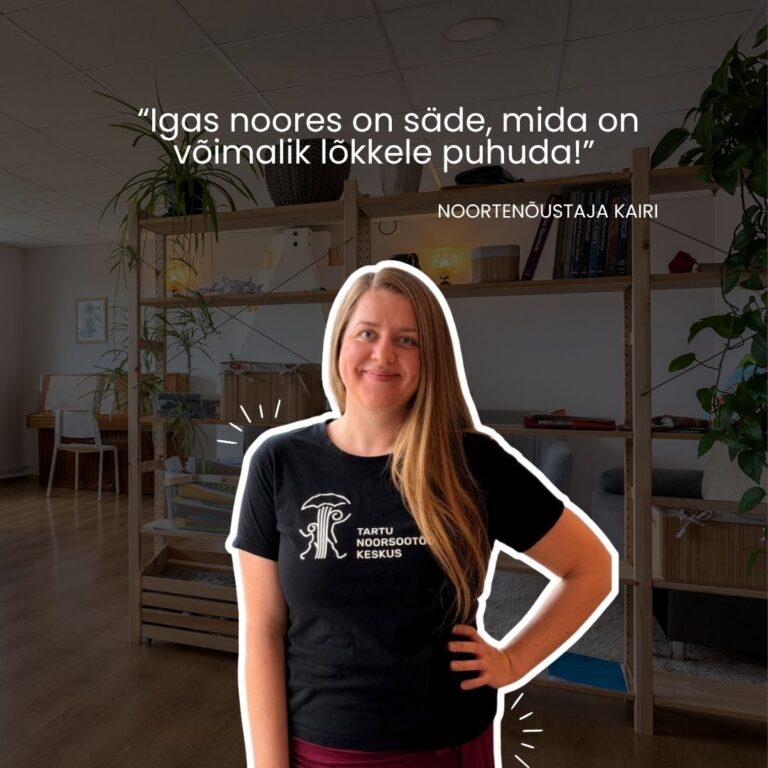
Who are you, and how did you end up working as a youth counselor?
I am a midwife by training, and I first came into contact with young people professionally while I was still studying to become a midwife, when I gave sex education lectures at schools. Later, I worked with young people more systematically—providing youth counseling services at a healthcare facility and visiting many schools and youth centers to raise awareness among young people about youth counseling services and sexual development.
It was extremely important to me to see that a young person who had seen me in class later came to my office hours and told me that I had made a trustworthy and warm impression on him or her.
What appeals to you most about this job?
What appeals to me most about working in youth counseling is the opportunity to support a young person’s development and growth in a way that allows them to realize their potential. By working with young people, we can contribute to ensuring that in the future we have healthier adults who are well-adjusted and capable of supporting and raising healthier children themselves. Every young person has a spark that can be kindled, and my hope is that they will learn to use that flame as a source of light and warmth, and to control it in situations where the fire could become destructive.
As a youth counselor, I hope to provide young people with a safe environment where they can open up and find tools to help them better understand themselves, learn to articulate their feelings, ask for help when needed, and find resources to turn to if necessary. My role is not to diagnose or treat anyone, but rather to listen and provide guidance—in collaboration with the young person themselves.
What kinds of issues can people come to you about?
When it comes to topics, I have no limits. If a young person feels they could benefit from an adult’s perspective, they can bring up any topic. School problems, home life, relationships with friends, what’s happening online, moods, changes related to adolescence, confusing feelings, etc. I’m not the kind of person who always knows the answer right away, but I promise to help find that answer. I’ll use my knowledge and network to ensure that the young person feels cared for and supported.
Does there have to be a major problem for someone to reach out to you?
Everyone assesses the magnitude of their worries based on their past life experiences. As a result, every worry isimportant, regardless of its “size.” If there’s a knot of thoughts that keeps circling in your head, makes your stomach churn, or keeps you from falling asleep at night—then you need to untangle that knot. It’s easier to do that together.
What happens when a young person comes to you but can't quite put their finger on what the problem is?
Sometimes we can’t quite explain exactly what the problem is. Some of the worries inside us have their roots in the distant past—a time we don’t even remember—yet our bodies react and tense up. This tells us that there’s some kind of old “wound” there. Other times, though, it feels like we simply can’t find the right words to describe our feelings or problems. That’s perfectly fine. I won’t force anyone to say anything, nor will I take it personally. This is a safe space to be and to learn to listen to and trust your body.
Will this conversation stay just between the two of us?
Our conversation will remain between us. Occasionally, I may need to consult with another specialist myself in order to better support you. If that happens, I will let you know.
What was one concern you had in your youth that you would have liked to talk to someone about?
When I was 10 or 11 years old, several difficult events occurred one after another in my life. My grandfather passed away, my parents divorced, and then my great-uncle, whom I loved very much, also passed away. That time was emotionally extremely difficult, and since I’m quite sensitive, I didn’t know how to cope with my emotions very well. I would often cry at school, which in turn caused problems. It would have been nice if I’d had professional support and understanding during that period.
What do you do to clear your head after a long day?
For me, spending time in nature is incredibly grounding. I especially enjoy watching the Emajõgi River flow by or the gently rippling surface of the lake at our country house, with the pine tree tops swaying in the distance. During the summer, I feel blessed when I can go swimming several times a day. It also brings a smile to my face when our little dog frolics right there, blissfully enjoying all the fun that water and mud have to offer.
If you could give your 15-year-old self one piece of advice, what would it be?
To my 15-year-old self, I would say: Trust your gut. Often, in uncomfortable situations, we try to please someone else or—even worse—out of fear of upsetting or offending someone, we put ourselves in an unsafe situation. Your “gut feeling” is an important signal through which your body sends you a crucial message—don’t ignore it, and trust your body.
Where and when can people usually find you? Can they just drop by, or do they need to make an appointment?
My workdays follow a schedule. On workdays, I try to spend as much time as possible with the young people in the youth room, but I also have my own office
on the second floor of the Lille building (room 27). I post
my schedule on the door so people can see when I’m in the building.
On Wednesdays, I’m at the Ilmatsalu Youth Center. You can always email me
at kairi.kivaste@tartu.eeor call me at 5626 0651. Since I move around the building, it’s best if we can arrange a meeting time in advance.