
Jaanika Palm
Jaan-Raul Ojastu
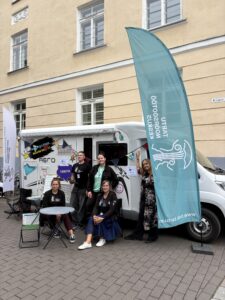
At the summer youth center located on Car-Free Avenue, it was possible to participate on several days in Estonian sign language learning workshops, which were conducted in cooperation with the Tartu Youth Work Center by the Estonian Sign Language Society (EVS) and the Estonian Deaf Youth Organization (EKNO).
The aim of the workshops was to introduce Estonian sign language, used as the second officially recognized state language in Estonia, and more broadly, the community of people who communicate in this language, to city residents of all ages. A sub-goal was to increase societal tolerance between different communities by raising awareness of the sign language community.
There are nearly 4500 Estonian sign language users: these are native and foreign signers who regularly use Estonian sign language either due to work or for other reasons (Laiapea et al. 2002: 4). Estonian sign language has been recognized in the Language Act of the Republic of Estonia since March 1, 2007. The first paragraph of § 5 of the Language Act (2019) states: "Any language other than Estonian and Estonian sign language is a foreign language".
The structure of the workshops was not designed for participants to learn signs as the first thing. Learning in the workshops took place through games, discussions, and active engagement.
For example, with the Estonian Sign Language Society, Alias was played using only body language and mime, and situations were resolved, also using only body language and mime. One might have thought these were entrance exams for pantomime or another drama school. This is how it might have seemed to visitors of Autovabaduse Puiestee when passing by the summer youth center area. But in reality, during this pantomime, it became clear that many words or action gestures in Estonian sign language are quite logical, such as reading a book, playing volleyball, riding a bicycle, etc.
In addition, participants learned the finger spelling (alphabet) used in Estonian sign language, and each practiced spelling their name. How to play trips-traps-trulli, broken telephone, etc. when you are not allowed to speak and can only give instructions or communicate using body language. Through these activities, participants learned about the activities, concerns, and joys of the Estonian sign language community.
Some workshops by the Estonian Deaf Youth Organization (EKNO) were also successfully conducted, and EKNO had two goals for these workshops. The first goal was to introduce and teach Estonian Sign Language. The second goal was to raise public awareness of the existence of sign language-speaking youth.
During the workshops, visitors were able to learn about Estonian sign language and the daily activities of the sign language community, including the obstacles they face within the spoken language community and how spoken language users can offer solutions to ensure sign language users are included in our society.
Obstacles can include, for example, access to information and communication with hearing people, as almost everything we use in daily life is based on hearing. For instance, not all films or series have Estonian subtitles or are translated into Estonian sign language. All technical devices are built based on hearing. Not all residents are proficient in Estonian sign language. The option to learn Estonian sign language as an elective is not available in all schools.
EKNO also had the opportunity to introduce two different aspects of deafness – the medical and the socio-cultural aspects. From a medical perspective, deafness is viewed as a disability whose severity depends on the degree of hearing loss. From a socio-cultural perspective, the focus is not on what is missing (hearing), but on what exists (sign language, a positive self-image based on it, deaf culture) (Laiapea, 2006: 78-79).
The Tartu Youth Work Centre and the Estonian Sign Language Society are continuing their cooperation, and within the framework of the project 'Reverse Inclusion in Society', Estonian sign language trainings will be held in schools, youth centres, and for specialists working with young people.
Additional information:
Jaanika Palm
Tartu Youth Work Center
Head of Ilmatsalu Youth Center
Jaanika.Palm@raad.tartu.ee