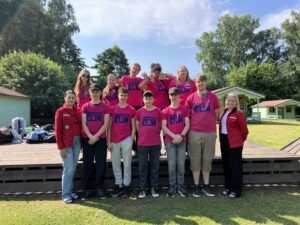

The Youth Summer Camp has concluded once again, and it's time to summarize. It was once again a vibrant Youth Summer Camp, which can be summed up in the words of one camper: “This was my first Youth Summer Camp, and it was so cool. I really enjoyed it!”
As youth work camp organizers, our greatest wish is to be able to offer their first youth work camp and work experience to as many young people without prior camp experience as possible each year. When planning the 2025 youth work camp summer, we set ourselves the goal of increasing the number of camp places specifically for 13-14-year-olds.
The goal was achieved thanks to the sub-institutions of the City of Tartu, in cooperation with whom we secured a total of 120 youth work camp places for 13-14-year-olds this year, which is twice as many as in 2024. In total, 222 young people aged 13-19 were able to participate in the Tartu Youth work camp, divided into urban and external camp groups. This summer, 13 new names were added to the ranks of employers, and there were a total of 28 different employers across 24 camp groups.
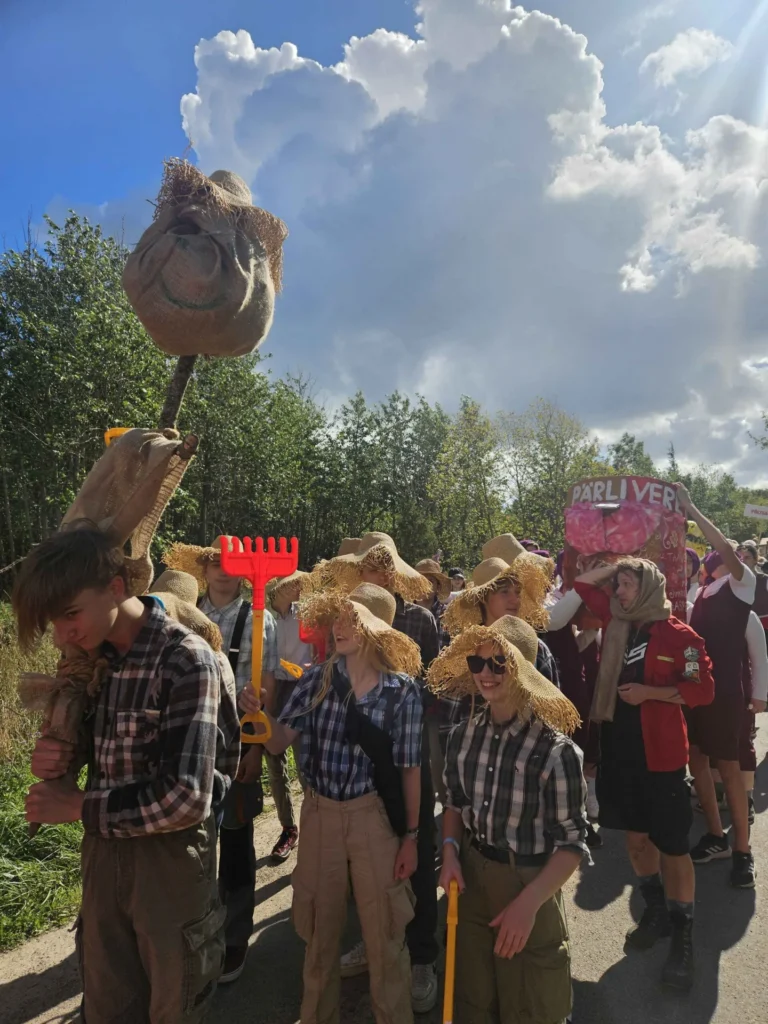
The Youth Summer Camp was opened on June 16 with an opening event organized by the camp's core group, where campers were greeted by both Margit Kink, director of the Tartu Youth Work Center, and Lemmit Kaplinski, Deputy Mayor of Tartu. Various camp groups worked in shifts until the nationwide camp gathering, which this year took place for the first time at Ranna Ranch in the second week of August.
This year, five urban groups of the Tartu Youth Work Camp had the first-time opportunity to participate in the special program 'National Defense ÕM 2025' organized by the Tallinn Student Work Camp and the National Defense Regiment. The Tartu Youth Work Camp City Museum group managed to achieve first place in the final trek of the national defense camp. According to the participating youth, the national defense camp was a very cool experience, and they would recommend it to a friend.
Although the main tasks this year were maintenance work, each Youth work camp group reflected its employer. The cemeteries group tidied up Tartu city cemeteries, the Tartu Youth Work Centre groups carried out deep cleaning in youth centres, the Rally Estonia group saw behind the scenes of the rally and tidied up the speed test areas, the Elistvere group worked at Elistvere Animal Park, and the City Museum group visited TYPA, the Tartu City History Museum, and the University of Tartu Botanical Garden.
A youth work camp is not just about acquiring work skills and earning money; we could even say that part is a bonus! The most crucial aspect of a youth work camp for a young person is initially somewhat intangible: the acquisition of new social skills and experiences. When applying for a youth work camp, it's important to remember that workdays are up to 6 hours long, depending on the group, but the overall camp days are longer.
The organization of the youth work camp would not be possible without employers, group leaders, caterers, accommodation providers, trainers, bus drivers, or the participants themselves! We thank everyone who contributed even the smallest help to the organization of the Tartu Youth Work Camp this summer, and we eagerly await the new year, because 2026 will be the 30th year of operation for the Tartu Youth Work Camp!
Youth work camp in numbers:
- 24 youth work camp groups, including 19 urban and 5 out-of-town groups
- 28 different employers
- 25 different group leaders
- 222 youth camp participants, whose average age was 14.97 years
- 16 caterers who prepared approximately 1500 lunches for groups within the city and 2000 food portions for groups outside the city
- 935 work hours completed in youth camps
We look forward to a new year, new friendships from the youth work camp, joint activities, a reunion, a national defense camp, and much more, because these are the things that make a youth work camp summer memorable!