
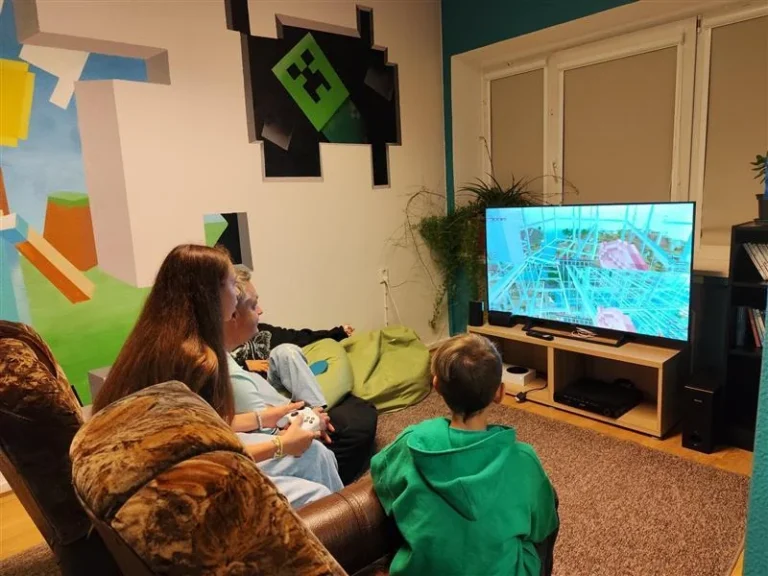
Minecraft, a word almost every child and parent in the Western world has heard. I used to always think I didn't understand this phenomenon at all. The game is so blocky, and they don't do anything there! Yet, all my acquaintances who play video games told me that if I just tried it, the game was made for my taste. Now, working in a youth center and frequently encountering Minecraft, which is by nature a sandbox game, I've started to understand the phenomenon much better and even play it myself. Its open nature and creative possibilities make it more than just a game; it's a powerful educational tool and a canvas for unlimited creativity.
Minecraft allows children to build and design their own virtual worlds. This freedom encourages creativity and imagination, as children can build everything from simple houses to complex cities, structures, and automated mechanisms. Minecraft can spark interest in science, technology, architecture, and mathematics (STEM). The game's mechanics involve basic engineering and programming concepts, and there are even educational versions, such as Minecraft: Education Edition, which is used abroad in classrooms to teach mathematics and history.
The game's block-based building system is similar to digital Legos or 3D modeling taught in art academies, offering endless possibilities for creative self-expression. Navigating Minecraft's 3D world helps children develop spatial awareness and thinking. They learn to visualize and manipulate objects in a virtual space, which can improve their understanding of geometry and spatial reasoning.
The game's survival mode requires players to gather resources, craft tools, and build shelters. These tasks involve critical thinking and problem-solving, as children must figure out how to use resources efficiently and plan their activities. The best part is the almost complete lack of instructions. You only get a response once you've managed to craft or assemble something, then an achievement notification appears, recognizing your discovery.
Minecraft can also be played by multiple people simultaneously, allowing children to collaborate with friends to build projects or complete challenges. This fosters the development of communication skills, as players must share plans and instructions with each other to achieve common goals. It's a fun way for children to learn the importance of teamwork, compromise, and guidance.
In short, it's easy to diminish something's functionality and educational potential by calling it a game or, oh horror, a video game. Minecraft's uniqueness lies in its simplicity. And in the game's blockiness, art and beauty emerge. Let's not fear children's interest in video games. Who knows, maybe Minecraft will inspire them to become an architect.
https://funtech.co.uk/latest/does-minecraft-make-you-smarter
https://www.tandfonline.com/doi/abs/10.1080/10400419.2019.1594524?journalCode=hcrj20
Article author Krõõt Lõbus