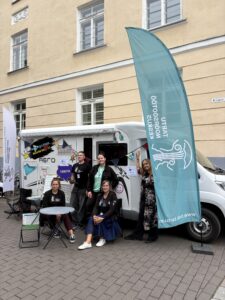

Youth Worker, Don't Forget to Take Care of Yourself!

Liisi Trumm

Head of Lille Youth Centre


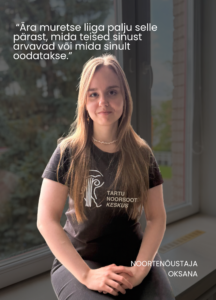
The recently concluded Youth Work Week's slogan #doyourselfgood effectively highlights the importance of mental health and connects the topic with youth work. The relationship between these topics can be examined from two aspects: first, how participation in youth work helps young people improve their mental health, and second, how youth workers themselves maintain their mental health. In this article, I will focus on the latter aspect, encouraging youth workers to take care of themselves.

Youth workers are often the type of people who are world-savers, always rushing to help when young people have problems. We are ready, trained, and open to solving the problems of others. How could it be otherwise, when initial counseling is one of the directions of youth work. At the same time, the slogan for Youth Work Week is not Do good for others, but “Do good for yourself.” But is it possible, in such a job, to remain untouched by the problems of others and thereby live by both mottos simultaneously?

It seems to me that one of the slogans mentioned earlier always needs repetition and practice. There are people who, either due to previous experiences or simply survival instinct, are very good at standing up for themselves, but in doing so, they forget that often it is other people who need protection or support. Then there are others who always worry about those around them, being extremely empathetic and taking on the emotions and worries of others, completely forgetting their own needs. These are the ones who send you a work email late at night, and if you reply immediately, they say: 'Why are you working now? You should be resting too!'

As previously mentioned, I believe that youth workers, like all professionals working with people, primarily fall into the second category. A good youth worker is empathetic, helpful, a good communicator, and trustworthy. All these qualities practically invite helping others, and indeed, that is what is expected of us in this profession. However, the problem arises when taking care of oneself is completely forgotten. At the same time, how much can we truly help others if we ourselves are not doing very well? When flying, flight attendants always remind us that in an emergency, put on your own oxygen mask first before helping others. Someone should also repeat this when you remember in bed at night that a work email was still unsent and sleep is gone, or when you cancel a spa trip with family because a few things still need to be tweaked.

Therefore, I urge all these world-saving youth workers to take care of themselves, because only by taking care of yourself can you provide young people with the best development opportunities and advice.
news:

Do digital environments bring us together or make us more lonely?

Have you ever had a day where you’ve been chatting with friends on Snapchat, Instagram, or Discord all day long, but still feel lonely in the evening? It might seem strange—how can we feel lonely when we’re connected to others almost all the time? Loneliness is a topic that’s being discussed more and more. According to the World Health Organization, about

Read more »

Philosophizing with Children and Youth

Many 21st-century skills are closely linked to thinking skills. These include, for example, creative and critical thinking, as well as a collaborative and caring mindset. These skills can also be developed in youth work through philosophizing with children and young people. Philosophizing creates more space for discussion and helps participants become more skilled at articulating their opinions, listening to others, making decisions, and

Read more »

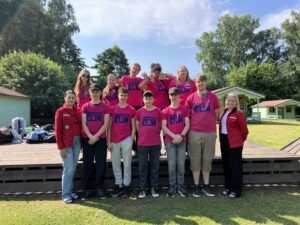
The Tartu Youth Work Brigade’s anniversary summer kicks off with a parade and an evening of work brigade songs

Today, June 15, Tartu will kick off the 30th summer of the Tartu Youth Work Camp, which will bring together 238 young people this year. The opening event of this anniversary year begins at 4:30 p.m. in the courtyard of the Anne Youth Center and proceeds with a parade to Town Hall Square, where the start of the work camp season will be celebrated with a speech by Mayor Urmas Klaas and the taking of the work camp oath. The opening ceremony will be followed at 7 p.m. by an evening of work camp songs in Tartu

Read more »

Ukrainian Youth in Tartu: A Week That Left a Lasting Impression

In early June, from June 8–14, the Tartu Youth Work Center had the extraordinary honor and pleasure of hosting young people from Ukraine—young people whose lives have been completely turned upside down by the war. The camp was made possible thanks to financial support from the City of Tartu, and the Tartu Youth Work Center wholeheartedly took on the task of organizing the program. The week began creatively—in a stencilling workshop, the young people

Read more »

A Children's Day bursting with joy and youthful energy!

The theme of this year’s Child Protection Day was the question: “A young person speaks—are you listening?” The need to be seen, heard, and truly listened to became clear right from the first preparatory meeting, where young volunteers had the chance to share which topics they consider important in the daily lives of children and young people. Almost without exception, all participants highlighted today’s fast-paced lifestyle—home,

Read more »

A mobile youth center will be on the move in Tartu this summer

From June 1 to September 1, the Tartu Youth Work Center is launching the MoNo bus—a youth center on wheels—as part of a pilot project, bringing youth work to young people at their everyday gathering places. It is a specially adapted van designed to provide young people with a safe and supportive environment in areas where youth work services are currently unavailable or where young people cannot easily access them on a daily basis. MoNo

Read more »

Youth workers from the Tartu Youth Work Center on a study trip to Portugal

From April 19–26, youth workers from the Tartu Youth Work Center participated in a study trip to Lisbon, Portugal, as part of the Erasmus+ program, to learn about local street youth work methods, non-formal education, and ways to support young people in the NEET situation. Study trips give youth workers the opportunity to step outside their usual work environment for a moment, learn about different practices, and bring the knowledge and effective solutions they gain back to their own community (Pavlakias and

Read more »