

I want to share a method with you that is exciting and useful, suitable for both young people and youth workers for self-reflection.
I learned this at the international training 'Mindful Bridges', which took place from September 7th to 13th in Portugal, and it seemed like a very valuable method for self-discovery.
The method was authored by narrative therapy specialist and community practitioner David Denborough from the Dulwich Centre in Australia, who described it in his book
“Retelling the Stories of Our Lives: Everyday Narrative Therapy to Draw Inspiration and Transform Experience” under the name Tree of Life (“The Tree of Life”).
The method was supplemented by Zimbabwean psychologist and narrative therapist Ncazelo Ncube-Mlilo and popularized by storyteller and blogger Nathan B. Weller.
The Tree of Life method is used to support people who have experienced traumatic situations (war, loss of loved ones, violence, bullying, etc.), to facilitate their coping with post-traumatic negative effects and to value their background, skills, and strengths.
To begin, we need a sheet of paper – as large as possible so all thoughts can fit – and a writing tool. Actually, a pen or a pencil is enough, but for those who want to make it more beautiful and illustrative for themselves, colorful markers, pencils, or crayons can be chosen.
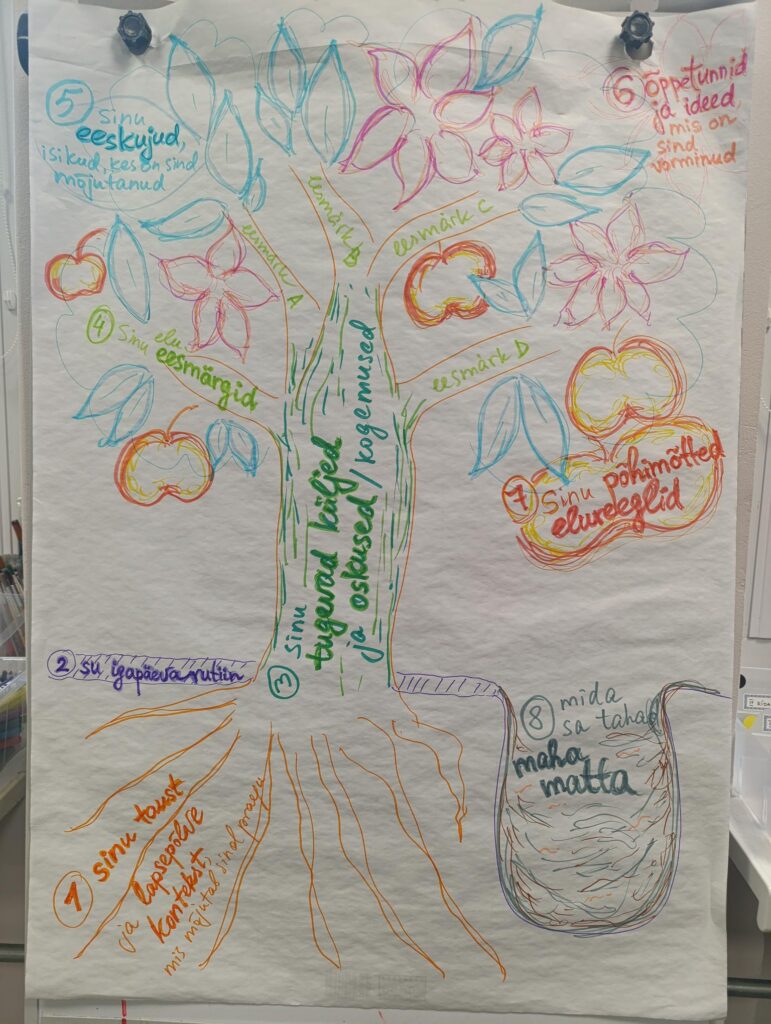
So what does the Tree of Life method look like?
In terms of time, we allow at least half an hour; if possible, more can be dedicated – this allows participants to concentrate better. For background, meditative music or nature sounds can be played.

Now we will start drawing our tree of life. Our tree of life has:
- strong, far-reaching roots that remain beneath the surface;
- thick powerful trunk;
- long branches that extend upwards and in different directions;
- large lush leaves on branches;
- beautiful flowers and
- juicy fruits on branches
- and a compost bin or pile under a tree, a little further away.
Let's start with the roots. Just as every living tree feeds from its roots, which reach deep into the soil, so too do the roots of our personality take us far back into our childhood and family history. Here we write down where we come from, what culture and language nourished us in childhood, what stories, beliefs, or circumstances have shaped us, and what activities, books, or places from childhood have influenced our future lives.
We emerge from underground to the surface. Here lies our daily routine, our current work (if chosen according to your wishes), or repetitive activities that we do daily out of free will to create rhythm and structure in our lives.
Now we will fill in the trunk part and write down our personal qualities, values, enriching experiences, and skills that will move us forward.
Branches are our short-term and long-term goals, dreams, and wishes. What do you want to be in the future? What do you want to achieve? Distribute these thoughts onto the branches all over the tree.
On the treetop, which consists of individual leaves or lush clusters of leaves, we write down the names of everyone who has influenced and supported us throughout our lives. These can include people and pets, both living and deceased or fictional (e.g., a book character), thinkers, writers, public figures, and others. It is important to remember that our tree is evergreen, and its leaves never fall, but remain with us forever, offering support and inspiration.
Next to the leaves are also flowers, which represent ideas, beliefs, lessons, and also significant material possessions that important people have bequeathed to you and which you carry forward and develop in your life.
From the blossoms, fruits develop – this is now our own legacy that we want to leave to others: our achievements, accomplishments, principles, and rules for life. If space becomes tight in the picture and the fruits no longer fit well, you can draw a separate platter with the fruits of your tree of life on another sheet.
A very important part of the picture is the compost pile (or compost bin) under the tree. There we write down everything we want to leave behind to move forward. Perhaps we want to let go of a traumatic relationship, a negative experience, or oppressive thought patterns. We try to look at this baggage with gratitude, because even what we put into the compost, which was painful, unpleasant, and hurtful at the time, shaped us into the people we are today. Over time, the compost becomes fertilizer for our tree of life.
One addition, which is not in the current picture but is used in work with young people who have experienced trauma, is a thundercloud, which approaches from the sky and signifies a crisis, a difficult situation, or a traumatic event that we cannot prevent or influence ourselves and which can be harmful to us. The tree itself can do nothing against a thunderstorm and is not to blame if it is damaged by lightning. The source of danger can also be a person with an axe or saw, fire, drought, insect pests, or pollution.
The 'Thundercloud' part of the Tree of Life method should only be undertaken if the facilitator is aware of how to handle negative emotions that may arise at that moment. If you decide to carry this out with young people, all the trees should first be gathered either in the middle of the room on the floor or on the wall to create a Forest of Life. As a metaphor for community, the Forest of Life shows how much stronger our Trees of Life are when growing together and supporting each other.
Once the tree of life drawings are collected, you can move on to the thundercloud part. The facilitator draws a dark cloud on a large sheet, which participants fill together with various dangerous factors, reflecting on their lives. By completing this task with others, participants gain distance from harmful situations and traumas in their lives. They discuss how these thunderclouds affect young people's lives and what feelings arise for those who have experienced them. Here, it is important to talk about feelings and traumas in general and not to focus on participants' personal experiences – this way, young people can express their thoughts without shame or self-blame, even if some may choose to talk about their personal experiences.
Afterwards, it will definitely be discussed again that no tree is responsible for damage caused by a thunderstorm or clear-cutting; that every storm passes and the sun returns to the sky afterwards; and that growing in a forest (i.e., in a community) makes it safer for trees to survive life-threatening situations. Finally, the groups can discuss how a tree grows in "good weather" and what we do when there are no storm clouds in sight – how we spend our time bringing joy and with whom we share that joy.
In summary, the Tree of Life method provides an excellent opportunity to focus on one's resilience and strengths. By going through it myself, I felt proud of myself and grateful to everyone whose names I wrote down in the roots and leaves sections. I warmly recommend this beautiful and impactful method for both self-discovery and youth engagement. Sunshine, fresh air, and spring water for our Trees of Life!
Julia Barsukova, youth worker at Anneke Youth Centre