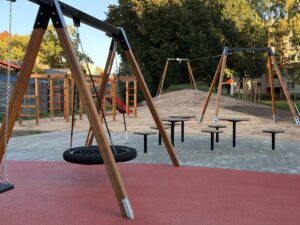

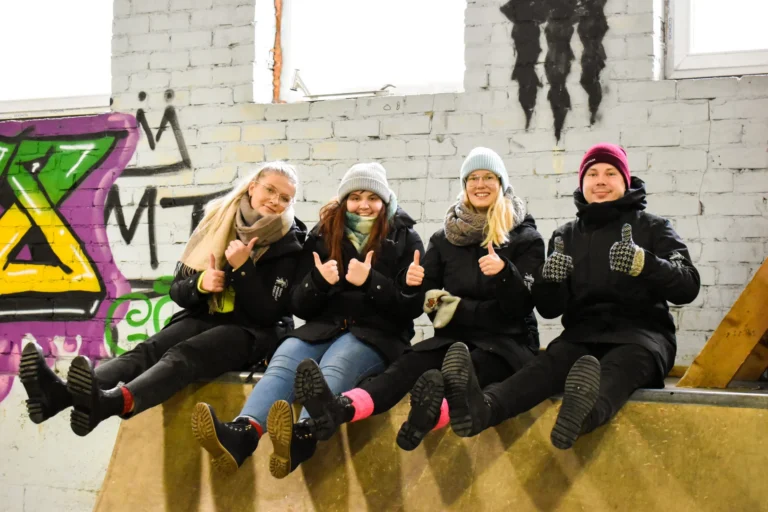
Summer has arrived, and with it, of course, the long-awaited long break. In public spaces, more young people can be seen spending time with friends, playing sports, or simply relaxing and chilling out. We are usually accustomed to moving along quick and convenient routes from work or school to home and the store. However, for example, between large apartment buildings, on playgrounds, near garages, in shopping centers, and elsewhere, there are various places where young people regularly spend time together.
Public spaces, especially streets, can be the only place where young people feel at home and free. To ensure that young people in public spaces are safe both physically and mentally, and that they receive adult support and assistance, mobile youth workers are operating in Tartu.
But what exciting creature is mobile youth work?
Street youth work, or mobile youth work (MONO), is a special form of youth work where specialists (mobile youth workers) engage with young people in their everyday environments – for example, on streets, in parks, shopping centers, sports fields, or elsewhere where young people gather and spend time (Tartu Youth Work Centre, 2022).
Mobile youth work is intended for all young people, but especially for those who are "off the radar," who do not regularly participate in extracurricular activities, are not connected to schools or youth centers, and who may lack a support network of close adults. Often these young people exhibit risky behavior or come from challenging backgrounds, but not always. On the streets, you can also find simply curious, self-exploring young people who need listening and understanding, or just those who spend their free time and meet with friends.
Young people are quite often startled when street youth workers approach them, thinking that plainclothes police officers are coming to reprimand them. I am happy to dispel this fear and assure you that unless a young person poses a direct threat to themselves or others, we have no reason or desire to call the police. We are here to listen, communicate, and understand, not to judge!
The main goal of street youth work is to establish contact and trust with young people who may be invisible or marginalized in society, and to make public spaces safer and more enjoyable for everyone. Youth workers help young people understand their choices, thoughts, and feelings, and guide them to necessary services when needed. Street youth work is also important for broadly introducing youth work and the opportunities available to young people for leisure and self-development at youth centers.
Every day in mobile youth work is different. Mobile youth workers usually move in public spaces during the second half of the day, visiting various youth gathering places and establishing contacts. Contact does not have to be long at all, and it is perfectly understandable if young people indicate that they wish to be alone at that moment. The main thing is that young people know we are there for them. Every contact experience with a young person is unique – whether it's a long philosophical discussion about why music is vitally important, discussing what kind of urban space young people would like, asking young anglers about the best bait for a fishing rod, or giving advice on how to prepare for admission interviews. There are also more serious topics, from mental health to addiction problems, but there are also simply exchanges of a few words about the weather. Street life is exciting and an adventure in itself.
Young people need to have their own place where they feel comfortable and an adult with whom they can speak without fear or judgment. Street youth work is not just about solving problems – it is a long-term process based on trust, during which young people can experience that someone notices them, listens to them, and is consistently there for them. Contact by contact, we can create a society with more joyful, healthy, and confident young people.
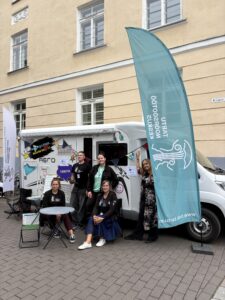
So, if you meet people on the street who have a Tartu Youth Work Center ID card, come say hello! It's a great pleasure to talk to you!
Article: Kerttu Kuku
Source used
Tartu Youth Work Centre, 2022. Erasmus+ "ABC of Street-Based Youth Work". https://tntk.tartu.ee/wp-content/uploads/2023/02/Kuj.-Street-Youth-Work-ABC-Learning-material-for-a-beginner-at-street-based-youth-work-koopia.pdf