
Jaanika Palm
Did you know that Estonian Sign Language has been recognized in the Language Act of the Republic of Estonia since March 1, 2007? The first paragraph of § 5 of the Language Act (2019) states: 'Any language other than Estonian and Estonian Sign Language is a foreign language.'
Based on this, and considering that the goal of the Tartu Youth Work Centre is maximum accessibility for all young people, during the implementation of the project "Reverse Inclusion in Society," we aim to introduce the Estonian sign language, used as a second official recognized state language, and more broadly the community of people who communicate in this language, to a wider audience (young people, and through them, parents; people working with young people). A sub-goal was to increase societal tolerance between different communities by raising awareness of the sign language community. The project is carried out in cooperation with the Estonian Sign Language Society (EVS) and is funded by the Ministry of Education and Research within the framework of the "For Youth 2021" project competition.
The project was preceded by discussions with young people, youth workers, and EVS, and we found that Estonian sign language education, or more broadly, the introduction of the culture of sign language users, has been insufficient so far. Furthermore, there has been no integration of young people (hearing and sign language users). The Tartu Youth Work Centre has been working on this for some time and aims to be an example for other institutions/schools.
First, the public will be informed through school students who participate in Estonian sign language lessons or information sessions via schools. For example, until November, information sessions on Estonian sign language and culture will be held every Monday morning and sometimes on other days at Ilmatsalu Basic School. Jaan Poska Gymnasium even offers an Estonian sign language course.
The trainers are native Estonian sign language users. Therefore, we also have sign language interpreters, but only at the beginning and during the first few lessons. Further instruction will be solely in Estonian sign language. Through the young people from these schools, knowledge of Estonian sign language will also spread to a wider circle – friends, parents, acquaintances.
To ensure a safe environment for young people in youth centers, we also train youth workers to acquire basic Estonian sign language skills, so that communication with young people is not hindered by a lack of language proficiency. Every Tuesday, youth workers gather for a lesson to acquire knowledge and skills in Estonian sign language.
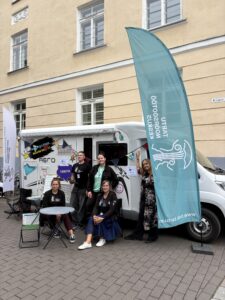
Since a sign language-speaking youth worker also works at the Lille youth center, continuous sign language learning also takes place at the youth center through activities and social media. As an example, previous activities on Car-Free Avenue can be mentioned.
Cooperation with EVS, youth centers, and schools will be continuous and sustainable. This will raise public awareness of the existence and activities of the Estonian sign language community.
The project will foster empathy and tolerance among young people, as well as among professionals working with youth. The impact of the project is planned to be lasting, meaning it will not end with the project's completion.
Questions about the project:
Jaanika Palm
Head of Ilmatsalu Youth Center and Project Coordinator
jaanika.palm@raad.tartu.ee
+372 58 803 271